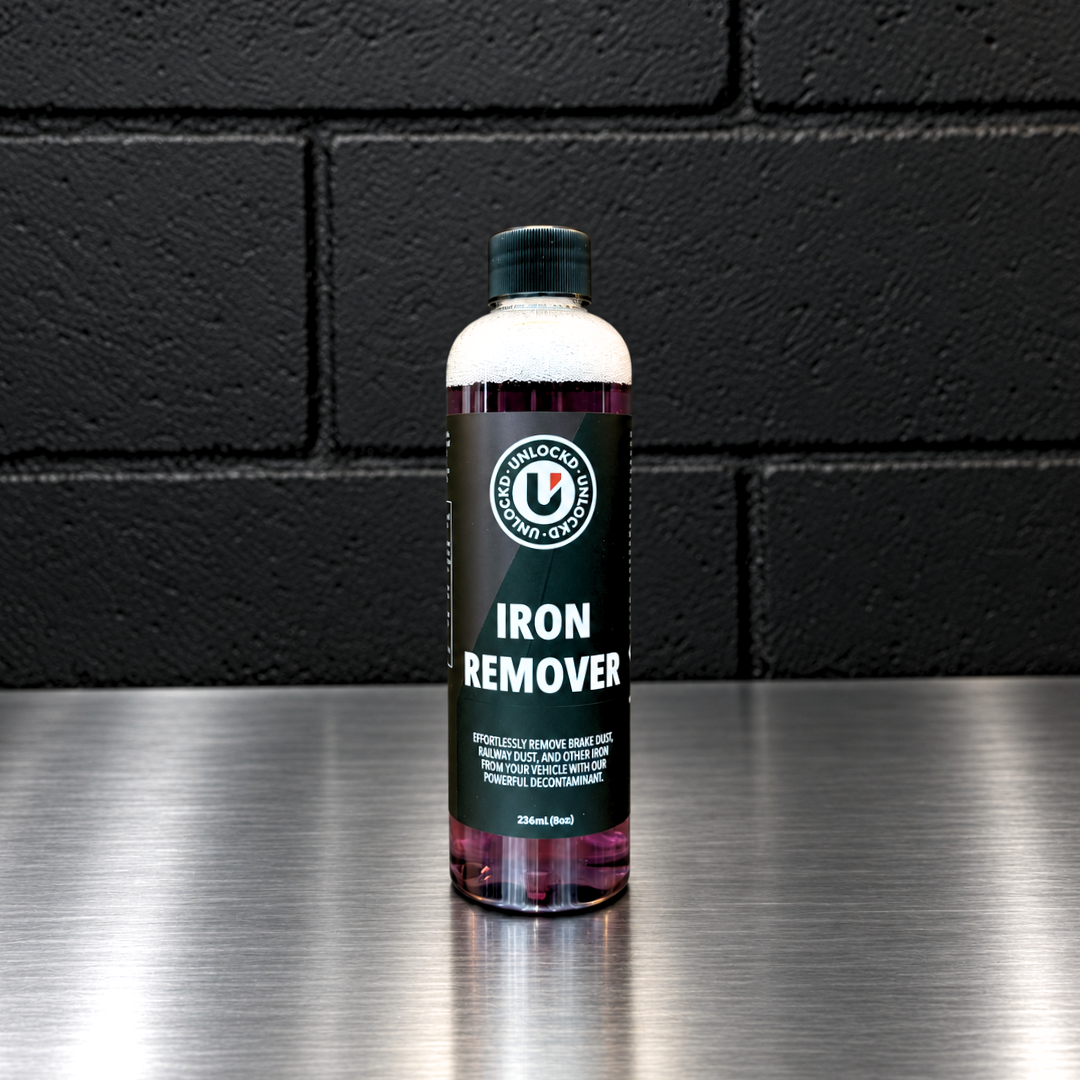
Iron Remover
Iron Remover
Couldn't load pickup availability

What does UNLOCKD Iron Remover do?
UNLOCKD Iron Remover is designed to dissolve embedded iron particles and ferrous contamination that normal car washing may leave behind. These contaminants commonly come from brake dust, rail dust, industrial fallout and other environmental sources, and can become bonded to automotive paint and wheels.
Iron contamination can appear as tiny orange or rust-coloured specks, particularly on white and light-coloured vehicles, or may simply leave a surface feeling rough even after washing. Using an automotive iron remover provides a chemical decontamination step that targets these particles before further detailing. It is especially useful when deep-cleaning wheels, decontaminating exterior surfaces or preparing a vehicle for additional detailing and paint-protection steps.
How do I know if my car needs an iron remover?
Your vehicle may need an iron decontamination treatment if the paint still feels rough after a thorough wash, you notice small rust-coloured spots on the finish, or the wheels have stubborn embedded brake-dust contamination. Iron particles can be difficult to identify on darker paint, so a vehicle does not necessarily need visible orange spots to have iron fallout present.
Daily drivers can accumulate contamination from braking systems, traffic, road debris and environmental or industrial fallout. Vehicles driven frequently in urban areas, around railways or in heavy traffic may experience greater exposure. Iron removal is also commonly incorporated into a more complete exterior decontamination process before polishing or applying paint protection.
Can I use UNLOCKD Iron Remover on both car paint and wheels?
UNLOCKD Iron Remover is intended for automotive exterior decontamination, including removing embedded iron and fallout from wheels and paint. These areas are two of the most common places for ferrous contamination to accumulate: wheels are continually exposed to brake dust, while painted surfaces can collect airborne iron particles and road-related fallout.
Always work on appropriate exterior surfaces according to the product directions and avoid allowing the product to dry during application. Wheels should be cool before treatment, and extra caution should be used with unusual, damaged, uncoated or specialty finishes. If you are uncertain about a particular material or finish, test a small inconspicuous area before treating the entire surface.
Does iron remover remove brake dust from wheels?
Iron remover specifically targets the ferrous component of brake dust, making it particularly useful for wheels with bonded iron contamination that ordinary washing or general wheel cleaning may not completely remove. This is different from simply cleaning loose road dirt, grease or non-ferrous grime from a wheel.
For heavily contaminated wheels, iron removal can be incorporated into a more complete wheel-cleaning process rather than expected to replace every type of wheel cleaner. Removing loose dirt first allows the iron remover to work more directly on the bonded contamination. Depending on the condition of the wheel, additional cleaning or careful agitation may still be necessary. Always rinse the treated area thoroughly and do not allow the product to dry on the surface.
Should I use iron remover before a clay bar, polishing or ceramic coating?
Iron removal is an important chemical decontamination step when preparing contaminated paint for more advanced detailing. It is generally performed after the vehicle has been properly washed and before mechanical clay decontamination, polishing or the final preparation stages for a ceramic coating, wax or sealant.
The advantage of using an iron remover first is that it chemically targets embedded ferrous particles instead of relying solely on a clay bar to mechanically remove contamination. A clay bar or clay pad can then address other bonded contaminants that remain. If polishing or applying protection afterward, continue with the preparation procedure required for that specific process. Iron remover itself does not polish paint, correct scratches or provide lasting paint protection.
Is iron remover the same thing as a clay bar?
No. Iron remover and automotive clay perform different types of paint decontamination. An iron remover chemically targets ferrous particles such as embedded brake dust, rail dust and iron fallout, while a clay bar or clay pad mechanically removes bonded surface contamination as it passes across a properly lubricated surface.
For a thorough detail, the two processes can complement each other rather than compete with each other. Chemical iron decontamination is typically performed first to remove as much iron contamination as possible without mechanically rubbing it across the paint. If the surface still feels contaminated afterward, clay can be used for remaining bonded material. Neither process should be confused with polishing, which is used to correct defects such as oxidation, swirls or light scratches in the paint finish.
How often should I use iron remover on my car?
Iron remover generally does not need to be used during every maintenance wash. It is better treated as a periodic decontamination product and used when the vehicle shows signs of bonded iron fallout, when wheels have accumulated stubborn brake-dust contamination, or when preparing the exterior for a more complete detail.
The ideal frequency depends heavily on how and where the vehicle is driven. A high-mileage daily driver exposed to heavy traffic, industrial environments or frequent braking may accumulate iron contamination faster than a lightly driven vehicle. Instead of following an arbitrary schedule, inspect the paint and wheels and use iron remover when contamination warrants it. This avoids unnecessary chemical treatment while still keeping bonded iron from accumulating over long periods.
Can iron remover remove the small orange or rust spots on white car paint?
If the orange or brown specks are caused by embedded iron particles oxidizing on the surface, an automotive iron remover is the appropriate type of product to target that contamination. These spots are particularly noticeable on white, silver and other light-coloured vehicles, although iron fallout can accumulate on paint of any colour.
Not every orange or brown mark is necessarily iron contamination, however. Staining, paint damage and actual corrosion can have a similar appearance and may require a different correction process. Wash the vehicle first and evaluate the surface before treatment. If contamination remains after proper iron removal, additional decontamination, polishing or professional inspection may be needed rather than repeatedly applying more product.
Does UNLOCKD Iron Remover need to be diluted before use?
Do not create your own dilution ratio unless the product directions specifically instruct you to do so. Iron removers depend on the intended working concentration to react effectively with ferrous contamination, so arbitrarily adding water can reduce performance and make results less predictable.
Apply UNLOCKD Iron Remover according to the directions supplied with the product rather than treating it like a concentrated all-purpose cleaner or car wash soap. The amount required will also vary depending on whether you are treating isolated contamination, a set of wheels or larger exterior areas. For that reason, the number of applications obtainable from a bottle cannot be accurately guaranteed without knowing the vehicle size, contamination level and amount sprayed during each treatment.
Is iron remover useful for Canadian vehicles and winter detailing?
Yes. Iron decontamination can be particularly valuable for Canadian daily drivers because vehicles are exposed to heavy traffic contamination, road debris, repeated braking and demanding seasonal conditions. After winter, a complete exterior decontamination can help address bonded contamination that remains after routine washing.
Iron remover should not, however, be confused with a road-salt remover, degreaser or general-purpose exterior cleaner. Its specific role is targeting ferrous contamination. A vehicle covered in winter salt, road film and grime should first receive the appropriate wash and cleaning process; iron removal can then be used where embedded iron contamination remains. This targeted approach gives each detailing chemical a specific job and provides a better foundation for subsequent clay treatment, polishing or paint protection.
PRO KITS SALE—UP TO 45% OFF
HAND-PICKED KITS FEATURING OUR TOP-PERFORMING PRODUCTS—UP TO 45% OFF
BUILD YOUR OWN KIT
ASSEMBLE ALL THE PRODUCTS YOU NEED, SAVE UP TO 20% OFF OF YOUR ORDER
Description
Professional-Grade Iron & Brake Dust Decontamination
The UNLOCKD Iron Remover is a professional-grade, acid-free decontamination solution designed to dissolve embedded iron particles, stubborn brake dust, and ferrous contamination from vehicle paint and wheels. Its color-changing formula reacts with iron contamination by turning red to purple, making it easy to see the product working while helping prepare surfaces for polishing, waxing, sealants, or ceramic protection.
Safe for painted surfaces and common wheel finishes, including painted, chrome, and powder-coated wheels, Iron Remover delivers the deeper chemical decontamination that regular car wash soap alone cannot provide. Made in Canada for enthusiasts, daily drivers, and professional detailers, it is an essential detailing step for restoring a cleaner, smoother surface and maintaining a properly decontaminated vehicle.
Professional-Grade Iron & Brake Dust Decontamination
The UNLOCKD Iron Remover is a professional-grade, acid-free decontamination solution designed to dissolve embedded iron particles, stubborn brake dust, and ferrous contamination from vehicle paint and wheels. Its color-changing formula reacts with iron contamination by turning red to purple, making it easy to see the product working while helping prepare surfaces for polishing, waxing, sealants, or ceramic protection.
Safe for painted surfaces and common wheel finishes, including painted, chrome, and powder-coated wheels, Iron Remover delivers the deeper chemical decontamination that regular car wash soap alone cannot provide. Made in Canada for enthusiasts, daily drivers, and professional detailers, it is an essential detailing step for restoring a cleaner, smoother surface and maintaining a properly decontaminated vehicle.
Directions for Use
Step 1: Wash & Prepare the Surface
Wash the vehicle thoroughly with car wash soap and water to remove loose dirt, road grime, and surface contamination. Rinse thoroughly before applying Iron Remover. For best results, work on a cool surface out of direct sunlight.
Step 2: Test Before Application
Test Iron Remover on a small, inconspicuous area before treating the entire surface, particularly when working with delicate, specialty, or aftermarket finishes.
Step 3: Shake & Apply
Shake the bottle well before use. Spray Iron Remover evenly over the desired wheels, painted surfaces, or other compatible areas requiring iron decontamination.
Step 4: Allow the Formula to React
Allow the product to dwell for up to 5 minutes. As Iron Remover reacts with ferrous contamination, the affected areas will begin turning red to purple.
Do not allow the product to dry on the surface.
Step 5: Agitate if Needed
For stubborn brake dust or heavily contaminated areas, gently agitate the surface with a suitable soft detailing brush, sponge, or clean microfiber towel.
Step 6: Rinse Thoroughly
Rinse the treated surfaces thoroughly with clean water, ensuring all product residue and loosened contamination are completely removed.
Step 7: Repeat for Heavy Contamination
If visible iron contamination remains, repeat the treatment rather than allowing the first application to dwell longer than recommended.
Step 1: Wash & Prepare the Surface
Wash the vehicle thoroughly with car wash soap and water to remove loose dirt, road grime, and surface contamination. Rinse thoroughly before applying Iron Remover. For best results, work on a cool surface out of direct sunlight.
Step 2: Test Before Application
Test Iron Remover on a small, inconspicuous area before treating the entire surface, particularly when working with delicate, specialty, or aftermarket finishes.
Step 3: Shake & Apply
Shake the bottle well before use. Spray Iron Remover evenly over the desired wheels, painted surfaces, or other compatible areas requiring iron decontamination.
Step 4: Allow the Formula to React
Allow the product to dwell for up to 5 minutes. As Iron Remover reacts with ferrous contamination, the affected areas will begin turning red to purple.
Do not allow the product to dry on the surface.
Step 5: Agitate if Needed
For stubborn brake dust or heavily contaminated areas, gently agitate the surface with a suitable soft detailing brush, sponge, or clean microfiber towel.
Step 6: Rinse Thoroughly
Rinse the treated surfaces thoroughly with clean water, ensuring all product residue and loosened contamination are completely removed.
Step 7: Repeat for Heavy Contamination
If visible iron contamination remains, repeat the treatment rather than allowing the first application to dwell longer than recommended.
Key Benefits
Deep Iron Decontamination
Dissolves embedded ferrous particles that regular washing may leave behind on paint and wheels.
Breaks Down Stubborn Brake Dust
Targets iron-rich brake dust and contamination to make heavily affected wheels easier to clean.
Color-Changing Reaction
Turns red to purple as it reacts with iron particles, providing a clear visual indication of the decontamination process.
Acid-Free Formula
Provides effective iron removal without relying on harsh acidic chemistry.
Safe for Paint & Common Wheel Finishes
Suitable for automotive paint and painted, chrome, and powder-coated wheels when used as directed.
Prepares Paint for Protection
Helps create a properly decontaminated surface before polishing, waxing, applying a sealant, or installing ceramic protection.
Easy Spray-On Application
Simply apply, allow the formula to react, agitate stubborn areas when necessary, and rinse thoroughly.
Professional Detailing Performance
Made in Canada for enthusiasts and professional detailers who want a more complete decontamination process and consistently cleaner results.
Deep Iron Decontamination
Dissolves embedded ferrous particles that regular washing may leave behind on paint and wheels.
Breaks Down Stubborn Brake Dust
Targets iron-rich brake dust and contamination to make heavily affected wheels easier to clean.
Color-Changing Reaction
Turns red to purple as it reacts with iron particles, providing a clear visual indication of the decontamination process.
Acid-Free Formula
Provides effective iron removal without relying on harsh acidic chemistry.
Safe for Paint & Common Wheel Finishes
Suitable for automotive paint and painted, chrome, and powder-coated wheels when used as directed.
Prepares Paint for Protection
Helps create a properly decontaminated surface before polishing, waxing, applying a sealant, or installing ceramic protection.
Easy Spray-On Application
Simply apply, allow the formula to react, agitate stubborn areas when necessary, and rinse thoroughly.
Professional Detailing Performance
Made in Canada for enthusiasts and professional detailers who want a more complete decontamination process and consistently cleaner results.
Pro Detailing Tip
Iron contamination is not always visible before treatment. Using Iron Remover as part of a thorough paint decontamination process can help remove embedded ferrous particles before polishing or applying wax, sealant, or ceramic protection. For heavily contaminated wheels, a second controlled application with gentle agitation can provide a more complete result.
Important Use Notes
- Do not allow Iron Remover to dry on the surface.
- Do not exceed the recommended 5-minute dwell time.
- Avoid application on hot surfaces or in direct sunlight.
- Always test an inconspicuous area before full application.
- Rinse treated surfaces thoroughly after use.
- Use appropriate detailing tools when agitation is required.
- Follow the vehicle or wheel manufacturer's care recommendations for specialty finishes.
Iron contamination is not always visible before treatment. Using Iron Remover as part of a thorough paint decontamination process can help remove embedded ferrous particles before polishing or applying wax, sealant, or ceramic protection. For heavily contaminated wheels, a second controlled application with gentle agitation can provide a more complete result.
Important Use Notes
- Do not allow Iron Remover to dry on the surface.
- Do not exceed the recommended 5-minute dwell time.
- Avoid application on hot surfaces or in direct sunlight.
- Always test an inconspicuous area before full application.
- Rinse treated surfaces thoroughly after use.
- Use appropriate detailing tools when agitation is required.
- Follow the vehicle or wheel manufacturer's care recommendations for specialty finishes.
Shipping & Processing
We process & ship out all orders within the first 24 - 48 hours of the order being placed.
Shop Our Best-Sellers
Proven formulas, trusted by detailers — built to deliver consistent, high-level results on every vehicle.
UNLOCKD
BUILD YOUR OWN KIT—SAVE 20%
Choose the products you need, skip the ones you don't, and save 15% on $200+, 18% on $250+, or 20% on $300+. Professional-grade, Canadian-made car care—built your way