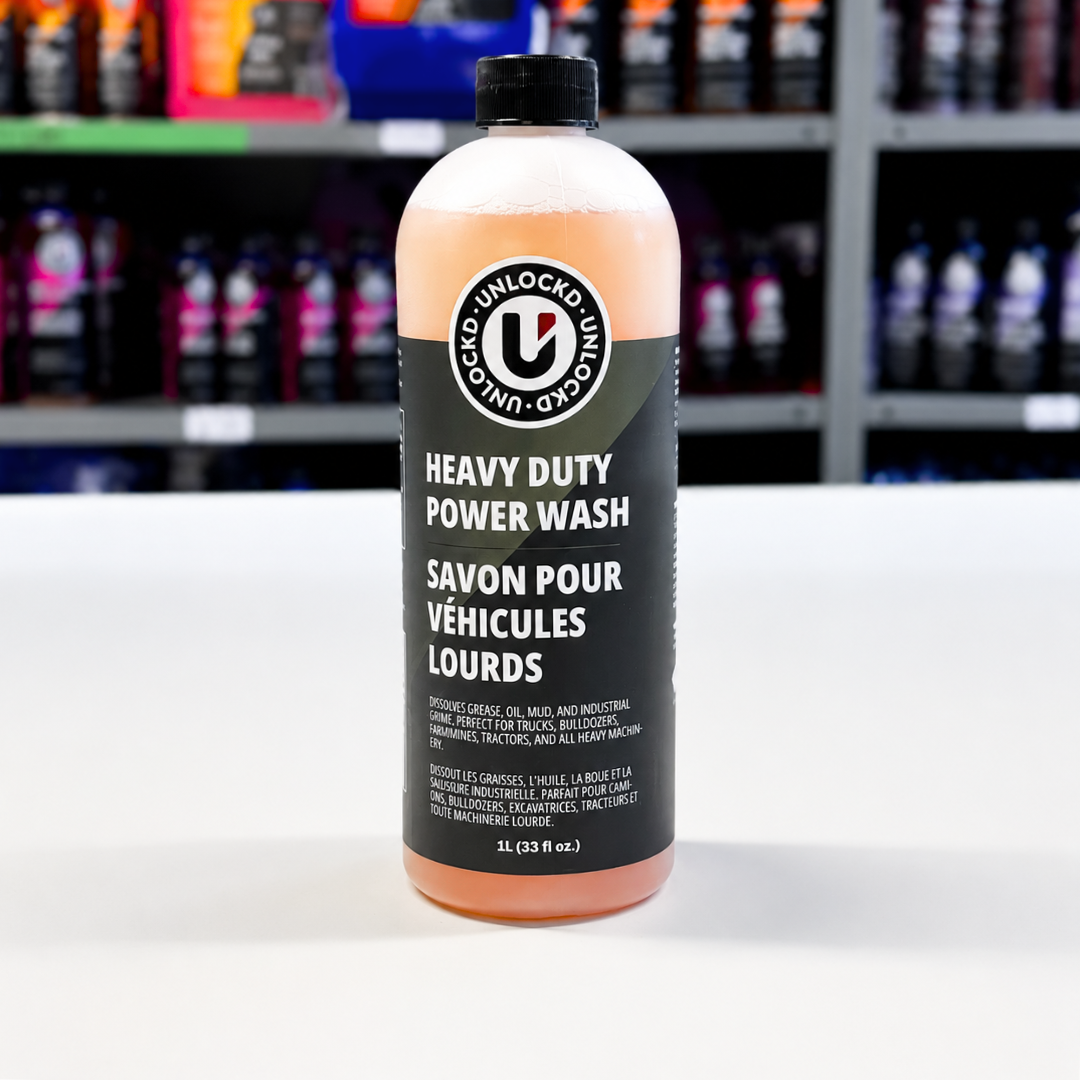
What does UNLOCKD Heavy Duty Power Wash Soap (V1 Formula) remove?
UNLOCKD Heavy Duty Power Wash Soap (V1 Formula) targets stubborn road film, greasy grime, exhaust deposits and accumulated insect residue. It is designed for pressure washing work trucks, commercial fleets and heavy machinery exposed to demanding conditions. The formula loosens contamination so it can be rinsed away, making it useful when ordinary maintenance washing leaves visible buildup behind. Expect a cleaner surface, rather than a waxed or coated finish. Particularly thick or baked-on grease may still require a separate, surface-appropriate degreasing step.
How is heavy-duty truck wash soap different from regular car wash soap?
Heavy-duty truck wash soap is intended for demanding cleaning jobs involving greasy buildup and persistent road film, while a maintenance shampoo is generally used for routine vehicle washing. UNLOCKD Heavy Duty Power Wash focuses on cleaning hard-working vehicles through foam cannon application and pressure rinsing. It makes sense for a pickup used on job sites or equipment carrying substantial grime. For a lightly dirty daily driver, choose a maintenance soap suited to its finish and protection. Select this formula according to the contamination you need to remove, rather than assuming stronger cleaning is necessary for every wash.
How much Heavy Duty Power Wash Soap should I put in my foam cannon?
The supplied directions specify 100 mL of soap added to warm water in the foam cannon solution bottle. However, they do not identify the bottle’s water capacity, so that amount alone does not establish an exact soap-to-water dilution ratio. Confirm the intended water volume on your product label or with UNLOCKD before mixing. Foam cannons also draw additional water from the pressure washer, meaning the bottle mixture and the solution reaching the surface are different concentrations. Do not increase the dose simply to create thicker foam; consistent coverage and correct use matter more than foam appearance.
Can I use this soap in a wash bucket, pump sprayer or pressure washer detergent tank?
The V1 Formula directions specify pressure washer and foam cannon use; they do not provide a bucket-wash or pump-sprayer method. Prepare the solution in the foam cannon bottle and use your pressure washer to apply and rinse it as directed. Do not assume a pressure washer’s onboard detergent tank or downstream injector delivers the same concentration as a foam cannon. Those systems require their own confirmed mixing and equipment guidance. If you plan to use a different delivery system, confirm the method with UNLOCKD before filling the reservoir.
How long should heavy-duty truck wash soap dwell before rinsing?
Allow 3–10 minutes of dwell time, provided the product remains wet throughout. Apply to a cool, pre-rinsed surface in the shade, and monitor it rather than leaving it unattended. If the foam starts drying before the suggested time has elapsed, rinse immediately. On a large truck or piece of machinery, clean manageable sections so you can rinse each area thoroughly. Longer dwell is not automatically better: never exceed the stated time or let the cleaner dry in an attempt to remove stubborn contamination.
Will Heavy Duty Power Wash clean my truck without scrubbing?
The formula is designed to loosen contamination before pressure rinsing, but a completely touchless result is not guaranteed on every vehicle. Cleaning depends on the type and amount of buildup, correct application, dwell time and rinsing technique. Begin by removing loose debris, then foam and rinse as directed. Inspect the surface before deciding whether further cleaning is necessary. If road film remains, use a separate contact wash appropriate for the finish. Do not compensate by letting the product dry, exceeding the dwell time or moving the pressure washer nozzle dangerously close.
Can I use Heavy Duty Power Wash on ceramic coatings, wax, PPF or vinyl wraps?
Compatibility with ceramic coatings, waxes, sealants, paint protection film and vinyl wraps is not established in the supplied V1 Formula information. Do not assume a heavy-duty cleaner will preserve every protective layer or specialty finish. Confirm suitability with UNLOCKD and check the maintenance requirements from your coating or film manufacturer before application. The same approach applies to matte paint and sensitive metal finishes. An inconspicuous test can help identify an immediate surface reaction, but it does not establish long-term compatibility or prove that existing protection will remain unaffected.
Can I spray Heavy Duty Power Wash directly on truck windows?
No. The V1 Formula directions specifically state to avoid direct contact with windows during application. Plan your foam coverage around the glass rather than coating the entire cab indiscriminately. Work in controlled sections and follow the product label for handling accidental contact; do not leave overspray sitting while the rest of the vehicle dwells. Clean the windows separately with a suitable automotive glass cleaner. This restriction also means the soap should not be treated as an all-surface exterior cleaner simply because it is intended for trucks and industrial vehicles.
How many washes will a bottle of Heavy Duty Power Wash Soap provide?
At the stated dose of 100 mL per foam cannon preparation, each litre of concentrate provides approximately 10 preparations. This is a mixing estimate, not a guarantee of 10 complete vehicle washes. A large truck or piece of equipment may require more than one preparation, depending on coverage and application technique. To estimate your supply, divide the container’s volume in millilitres by 100, then account for how many preparations you actually use per job. Tracking consumption across a few washes gives fleet operators a more useful cost-per-vehicle figure.
Does Heavy Duty Power Wash prevent rust or replace rustproofing?
The V1 Formula is described as helping control flash rusting and corrosion during cleaning, but it does not replace rustproofing or a dedicated protective treatment. Flash rusting refers to rapid surface oxidation that can develop on exposed metal after wet cleaning. That cleaning-stage benefit should not be interpreted as lasting protection against Canadian winter conditions or as a treatment for existing rust. Rinse thoroughly, dry accessible areas and follow the vehicle or equipment manufacturer’s care requirements. Any ongoing corrosion protection should come from a separate product or service intended for that purpose.